Poems for Healthcare Staff
“I was at a birth recently and thought: This is why they are so afraid of us. They can’t control this” She sat on her couch with a mug of coffee. She is a queer, femme, mother of two who has worked in reproductive health for over two decades.
He ended up talking about his son, who is now his daughter. Another part of his experience of continual growth and soul-opening.
This nurse was considering leaving a position where she spent many years due to issues she experienced and witnessed at her hospital.
Many of the people he worked with had to develop a new identity in the context of their caregiving responsibilities. “It’s as if they need to become a new variant of themselves.”
“We’re taught to enter a room with a specific goal... with assumptions... with a hypothesis about what may be going on with the patient.”
She believes that most of those who have connected with ACS began with a personal connection, but then, according to her, “you evolve, and you shift.”
With her background in counseling and psychology, she works to bring people together and support patients.
Although at times she becomes discouraged about the inequalities in the world, she is determined to do her part by making sure everyone has access to quality healthcare.
This person radiated gratitude and hope. She shared that she discovered she was expecting a son just before receiving a lung cancer diagnosis at the age of 31.
She had an epiphany as a child — that love could heal the world. Now, as a seasoned physician, there’s still a part of her that believes in the power of love, but not with the same idealism she once held.
He talked about recently speaking with a patient who experiences migraines: she is seeking the truth, he is seeking the truth to find a way to work with her, wanting to give more than a diagnosis and prognosis.
To her, the surgical world has felt like “a wheel that keeps spinning,” a seemingly endless pursuit towards an undefinable goal.
While she kept an open mind throughout medical school, the field of OB/GYN ticked off all the boxes for her.
“The historic traumas of African-American women — all African-Americans — lead us to not be the first people at the doctors, nor the first to get surgery.”
“Sometimes I feel so helpless,” said this resident, reflecting on all of the challenges faced by the young patients and their families whom she served. Over the last several days, she has become increasingly overwhelmed by events in the news and has questioned her ability to make a difference in the world.
Her childhood was infused with Hawaiian-Polynesian music and dance, taught to her father by his mother. Today, her life’s work is to connect the unbelievable discoveries of molecularly focused pre-clinical research directly to the patient experience of treatment.
She is a single mother born to a single mother and had to grow up fast. She is juggling a sticky work situation, her own anxiety and depression, and being away from home and her kids.
I was invited to create a group poem for forty participants at the Arts in Healing luncheon, hosted by the Inova Health Foundation in partnership with the board.
“I’ve experienced a lot of big losses,” she said. “I want to be a beacon of hope and light, keeping the flame lit for cancer prevention.”
Professionally, for this person, Henrietta Lacks’ story represents the need to critically examine our research infrastructure.
“I can’t see a future outside of our relationship,” she tells me, “but I also can’t see a future outside of residency.”
On why she chose colorectal surgery, she explained that the colon is an intimate and essential part of the body that people often ignore due to self-consciousness.
When we met, she was coming off a stretch of nine 14-hour shifts. She was tired but in good spirits.
She was very proud of her daughter and has hopes for “a bright future that’s as pain free as possible”
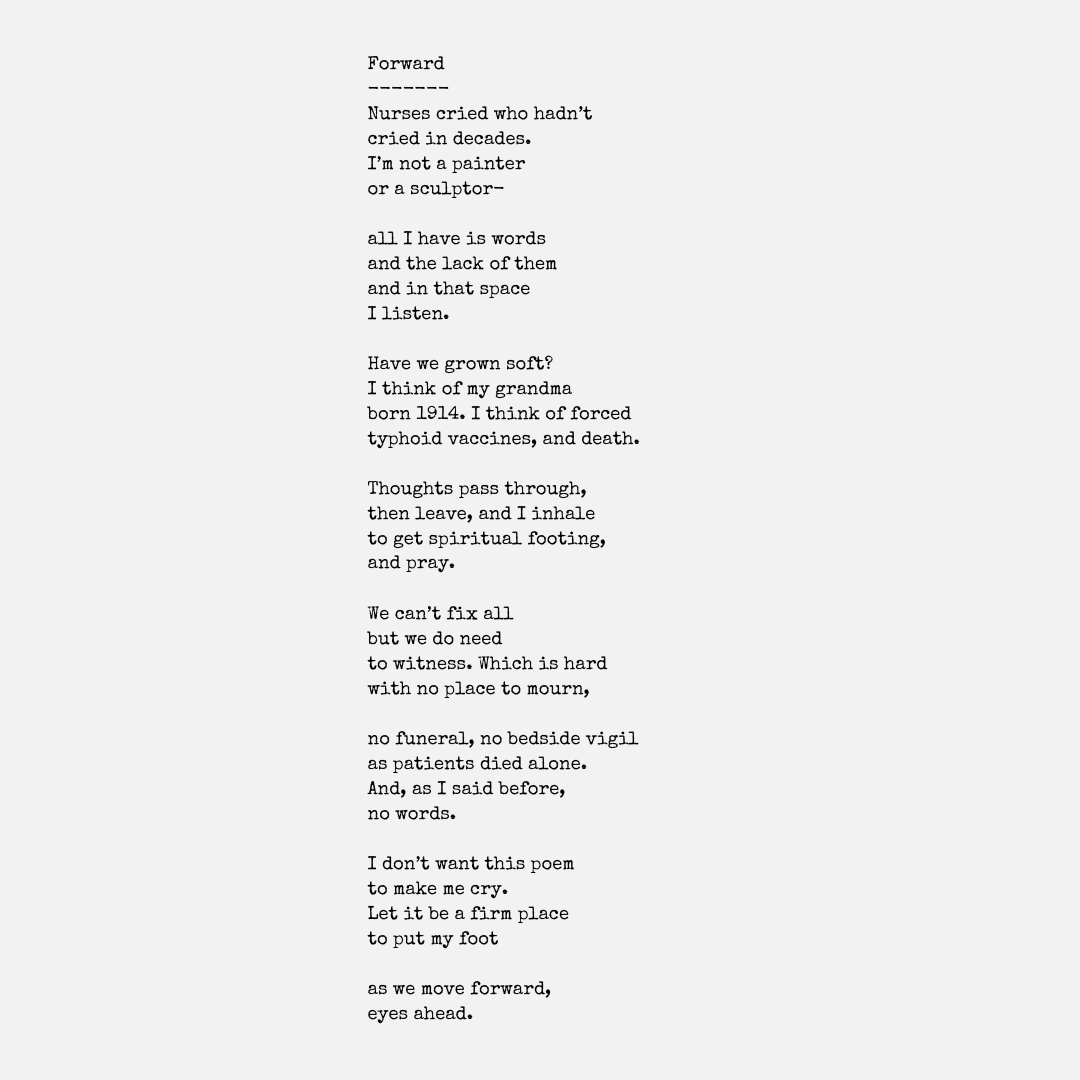
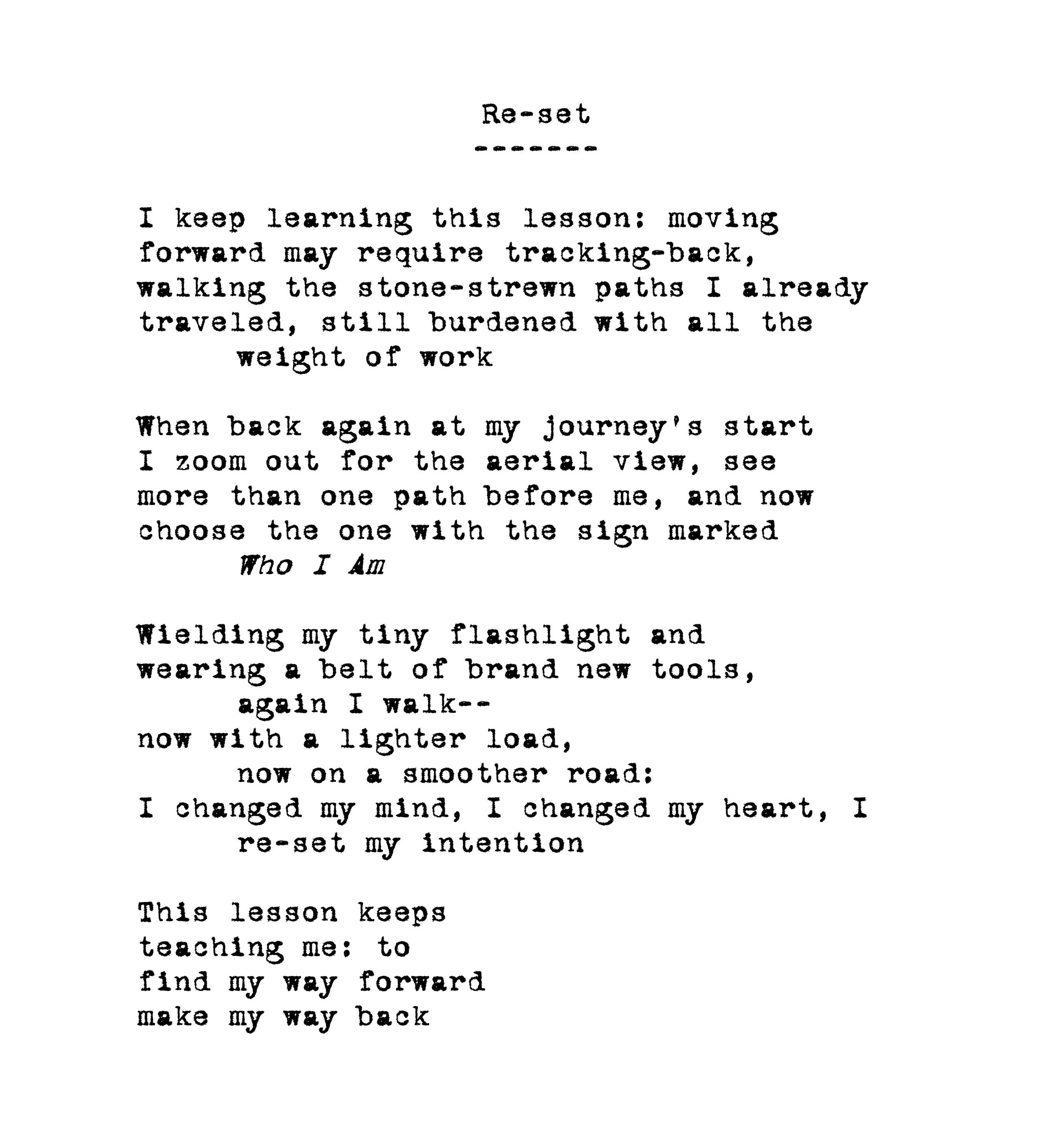
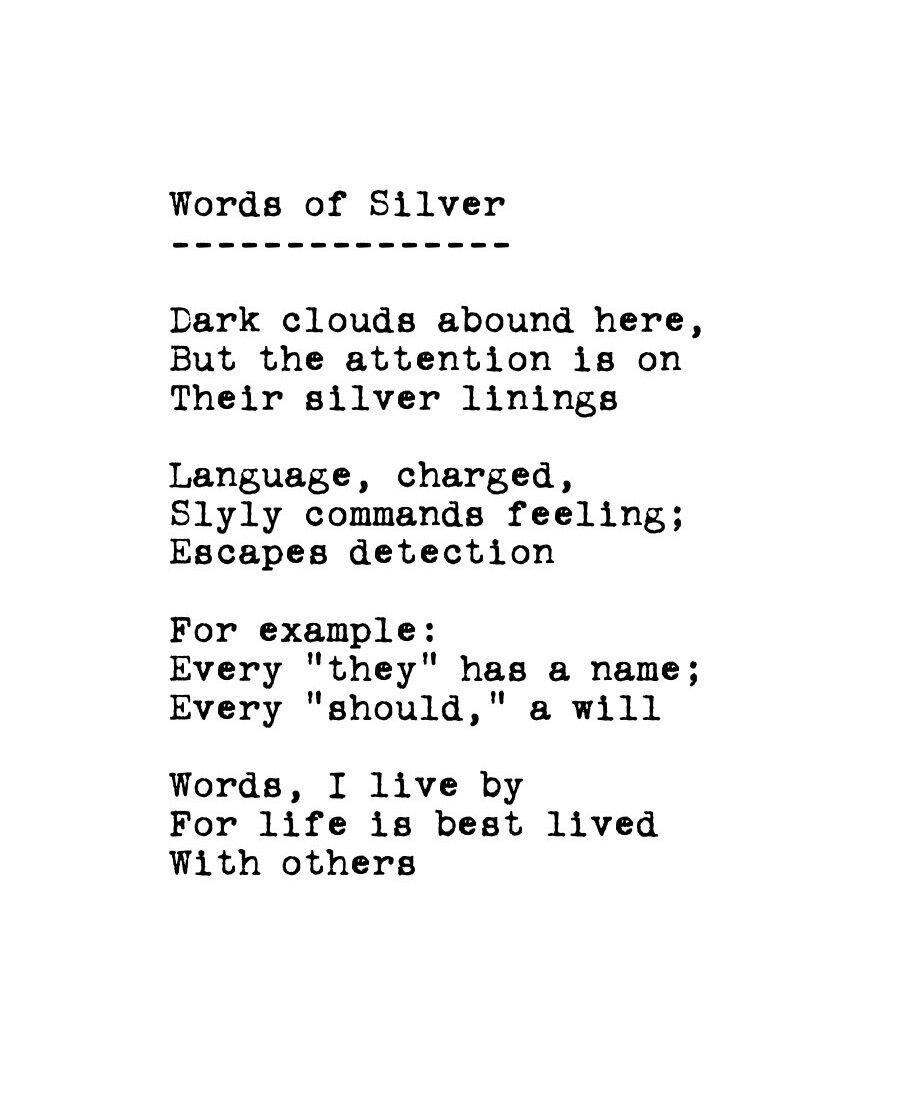
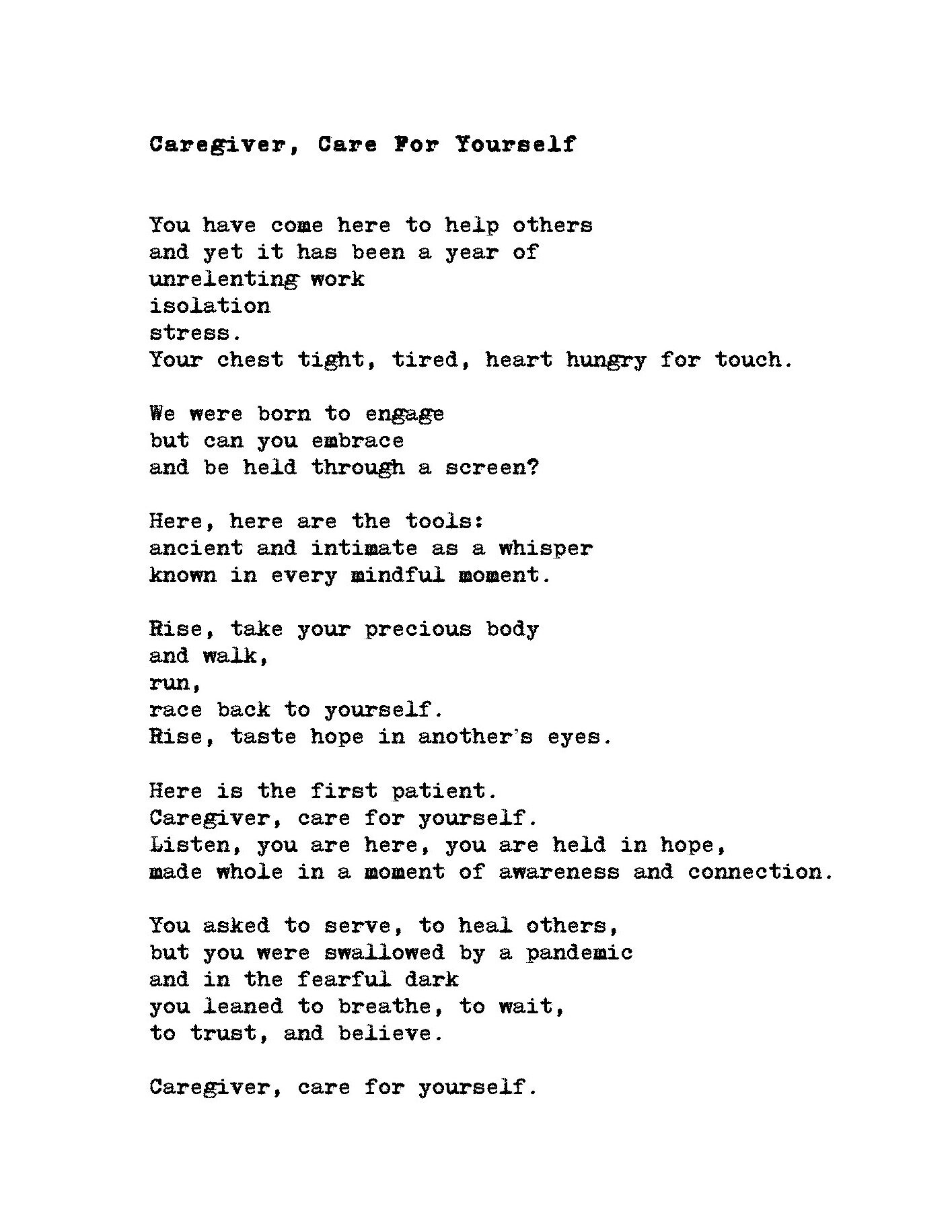
These poems are inspired by the stories of healthcare staff.
Explore all poems for healthcare staff
He ended up talking about his son, who is now his daughter. Another part of his experience of continual growth and soul-opening.
Many of the people he worked with had to develop a new identity in the context of their caregiving responsibilities. “It’s as if they need to become a new variant of themselves.”
“We’re taught to enter a room with a specific goal... with assumptions... with a hypothesis about what may be going on with the patient.”
“I’m trying to focus on doing little things to make people feel better during everything that’s going on in the world,” she told me.
She was in the depths of transition and change in this “concentrated time.” As we sat for our Listener Poet session, she opened to the grief of the non-traditional losses she has been experiencing.
“I'm continuously questioning: did I do it right?" she said. "I’ve always done a good amount of second-guessing, but I’m re-learning how to show up differently.”
"It changed me; It changed the way I look at life," said this woman about her profound experience during her pregnancy.
“It’s been more challenging than normal lately,” she said. “I’m only one person. It's a struggle for me to say no, but I can’t do everything that’s being asked of me right now.”
"I've been processing how to make the most of the small amount of life we have to live," said this physician.
Spending time with his grandfather before he died left him pondering big questions like, “what is a sense of self?”
“I like feeling small,” he told me. “Nature has always made me feel small.” He described the sense of wonder that feeling gave him.
“I feel like I have decision fatigue,” she told me. It was normal for her to make many choices at work, but COVID had dramatically increased the number of medical decisions she had to make at home.
This physician discussed being the only one in his practice network with expertise in patients with a specific type of chronic pain.
“Our constituents are uniquely affected by the pandemic,” they said. This poemee was an educational psychologist who spoke about how much they missed working in person with med students, healthcare staff, and medical educators.
"I grew from the experience – though I think it aged me 10 years!" This is how a resident described a turning point with a specific patient when he recognized how burned out he was.
Although he had been through many stressful experiences in his life and recently, he always held onto his positive outlook. He took particular care to use words intentionally, paying attention to their connotations, so that his positivity extended to those that he interacted with as well.
“There’s a constant feeling inside that I should be doing more,” she said. “But I also want to be kind to myself and recognize all that I’ve given.”
These members of the Wellness team in the Department of Neurology at the University of Colorado each spoke about the importance of community and connection.
He brought the tools of mindfulness and self-care to medical students, many of whom had been studying all this past year, 10 hours a day, day after day, in isolation.
He had recently lost his father to COVID-19 and was reflecting on forgiveness. For the majority of his life with his father, they did not have a positive relationship. However, in the last three years of life, his father lost his memory and his personality changed into someone who was loving and kind.
She was very proud of her daughter and has hopes for “a bright future that’s as pain free as possible”
“I know ‘vibe’ is kind of a nonspecific term, but I think about people’s vibes all the time,” he said.“ Sometimes you come into a room and it’s just off.
She said she wanted a poem about the importance of CPR. As both a nurse and a CPR instructor, she spoke about how the rhythms of certain familiar songs helped her students internalize the rate of compression required.
The pandemic had forced this woman to slow her life down drastically. Before, she’d travelled around every month for work, never stopping, working hard because she cared about her job. The slower pace created by social distancing had reminded her to cherish everything that life had to offer outside of work.
“I’ve always loved hearts,” she said. She was a cardiac nurse who had been drawn to a job in the catheterization laboratory. “It’s so rare to have an opportunity to immediately do something good for somebody, but it happens often in the cath lab,” she told me.
“When you get to hear the hidden sides of people’s stories, you never look at people the same,” she said, with a noticeable tenderness in her voice. This woman was a therapist who supported physicians and residents. “Sometimes as I lay in bed at night I inhabit the stories people share with me.”
She began her career as a hospice volunteer and then worked as a critical care provider in the Emergency Department for many years. She told me she always wanted her patients to feel empowered while in her care. “This feeling has to do with quality of life,” she said.
For a long time, he had used songwriting to turn his own emotions into artwork, but in the past eight years he had turned the process into a service for others. He’d learned that listening to people’s stories and reflecting them back in an artistic format was a cathartic experience for them.
This person described himself as a dreamer. As he spoke, he painted a particularly clear and vivid vision of the future he saw possible for the VA. He worked in diversity, equity, and inclusion, and his passion for the work was evident and inspiring.
This woman was part of a small but mighty team that ran the Innovation Ecosystem within the VA. She arrived visibly excited to share about their work, and after learning more about it, I understand why.
She talked about how hopeful med students feel when they first start out, and told me she worried that it would get harder for doctors to hold onto hope and empathy the further along they were in their careers.
He had been thinking a lot about race over the past several months. He’s a White man with two children: a 20-year-old biological son who is White, and an 18-year-old adopted daughter who is Black.
She’d been in a physician leadership role with the VA for seven years. Over her tenure, she’d never seen the system rise as one team like this. “There’s so much we don’t know about COVID. But our teams are stepping up in ways I could never have imagined.”
“I have a lot of unresolved grief,” she confessed. It was her grief that made her good at empathizing with the hospice community she served. “Would resolving my grief make me less effective with my patients?”
She worked as an interpreter at Schar and wanted her poem to be “thanks for allowing me.” Her background in a very repressive regime gave her a unique perspective about the gift of being able to live here, although she had felt anxiety for the past few years.
We talked when she had a quick break during her shift at the Infusion Center. She told me how important it was for her to make the most of the moments she had to make connections with people.
"I’m ensconced in the system." He was getting paid quite well to do his job in the healthcare sector, but he had internal conflict about how the system worked. He asked me, "Did you know that about 50% of healthcare dollars are spent on the last six months of life?"
She said she wanted a poem about her mother, who died in October at the age of 90. She painted a compelling portrait of a mother who loved glitter, high heels, and jewelry, while living on a dairy farm.
“Relationships — children, grandparents, siblings, spouses, parents are all a reflection of your journey,” she said. “They can be fulfilling or agonizing."
“It feels like time is running out to make big changes,” she shared. The last 6 months were full of transition in all aspects of her life.
Being in healthcare can be extremely rewarding, but it comes with the occupational hazard of loss. This woman loved the work she did with dementia patients and the connections she was able to form with them. However, she also struggled with the frequent loss of people she had bonded with.
He was an ICU doctor at a hospital in a big city, facing the pandemic head on. Having met him years ago, I noticed during our video chat that he'd shaved his longtime beard. “The N95 mask is a harsh master,” he said.
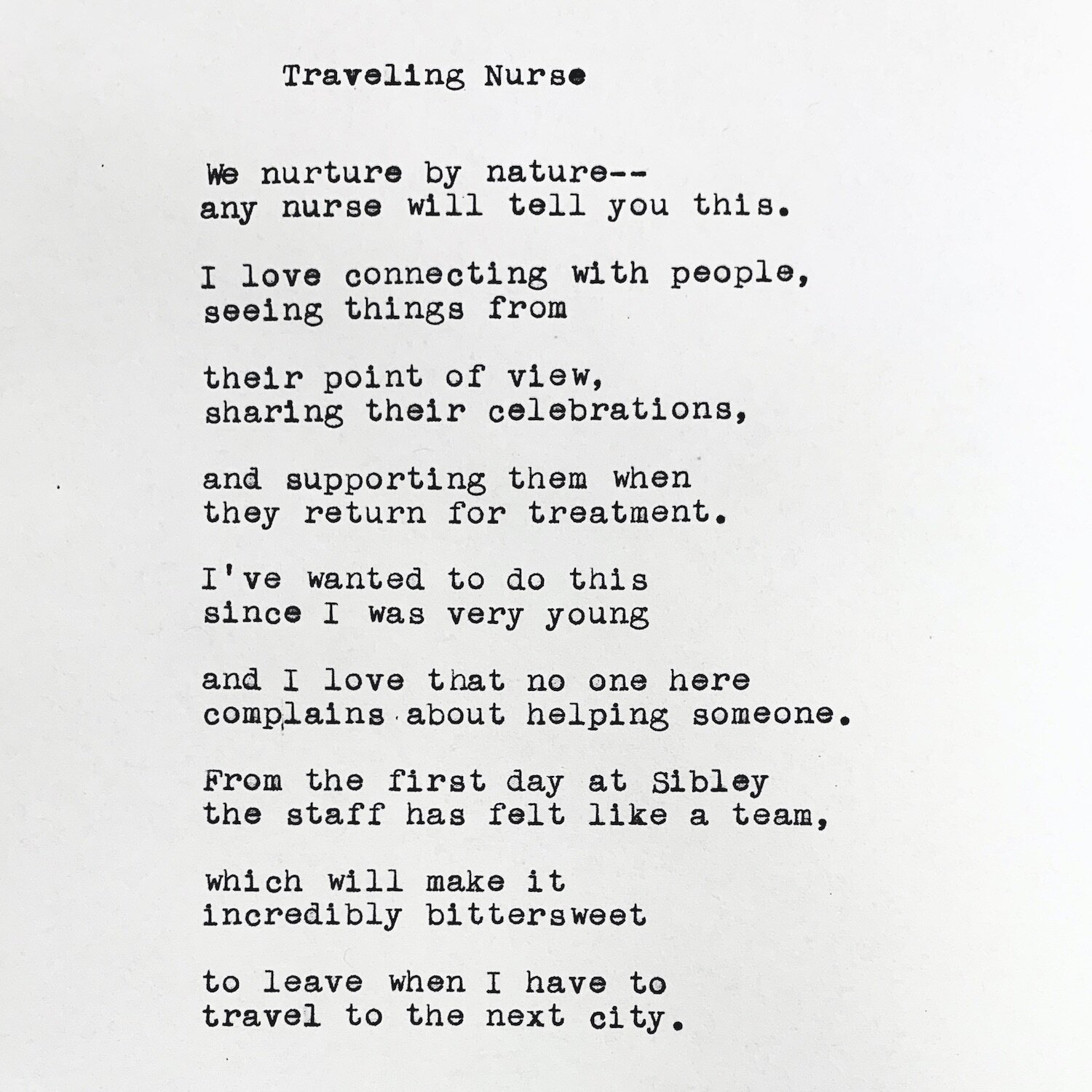
She told me that she had lived in Florida for 50 years but now that she had an empty nest, she’d become a traveling nurse so she could live in different places. “I was only supposed to be in D.C. for three months,” she said, “but now I’ve been here for nine because I just love it so much.”
The five of them work together in a Pediatric ER unit. “People die here,” one exclaimed, and part of their job is to bring light to a dark place.