Origin Story
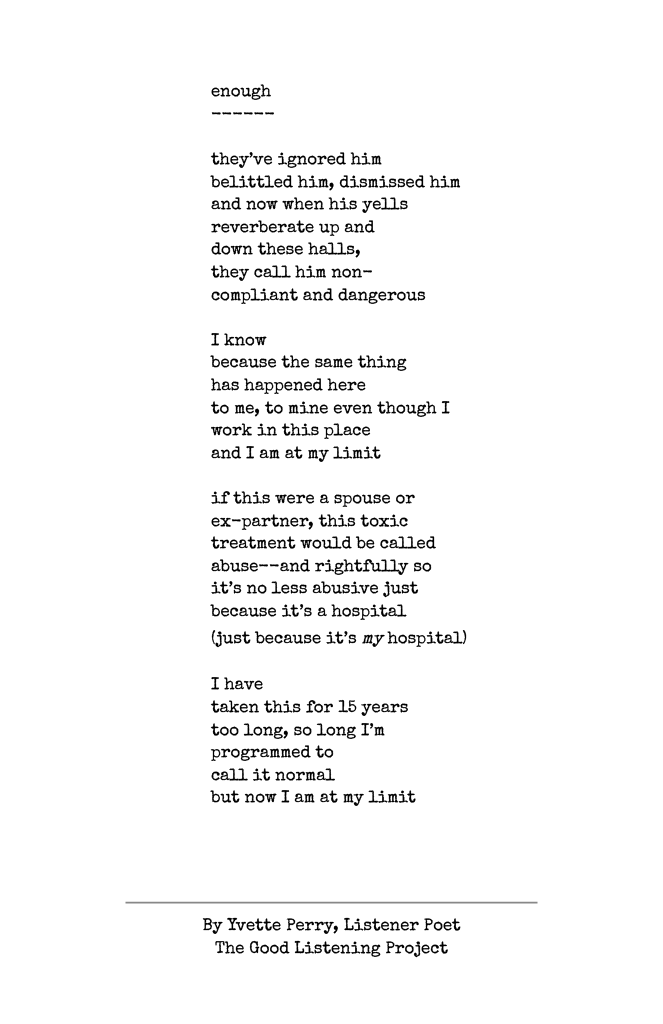
This nurse was considering leaving a position where she spent many years due to issues she experienced and witnessed at her hospital. Even though she worked there and was known to the healthcare providers, she experienced repeated incidents of disrespect and substandard care at the hands of her colleagues. Worse, she had experienced similar treatment with her own children and mother when they tried to receive care at her facility. “This is not a happy place,” she said of her workplace.
She expressed surprise that there were not more cases of care going wrong—but then upon further reflection stated that things probably went wrong more often than patients are willing to report. Stating that this was especially the case in situations where race was an issue, she observed that her workplace claimed to embrace multiculturalism, but that not everyone was invited into the culture of the institution.
She recognized that even though she had been in this environment for a long time, she had finally reached the limit of what she was willing to endure. She knew that she wanted to work in an environment characterized by support, encouragement, appreciation, politeness, and respect. In her home life that she shared with her husband, children and pets she was happy. “I need that kind of happiness in other areas of my life, too.”
Yvette Perry, Listener Poet
Institute for Healthcare Improvement Forum
January 2024
Presented at the National Council on Family Relations Annual Conference 2025
enough
By Yvette Perry, Listener Poet
they’ve ignored him
belittled him, dismissed him
and now when his yells
reverberate up and
down these halls,
they call him non-
compliant and dangerous
I know
because the same thing
has happened here
to me, to mine even though I
work in this place
and I am at my limit
if this were a spouse or
ex-partner, this toxic
treatment would be called
abuse--and rightfully so
it’s no less abusive just
because it’s a hospital
(just because it’s my hospital)
I have
taken this for 15 years
too long, so long I’m
programmed to
call it normal
but now I am at my limit
they’ve clothed me in
gray scrubs made
of their offensiveness
and yet, to them, I’m naked
this place is
gray and soul-less
and yet, to them, it’s fine
I deserve
more joy, more support
more respect than
this place is willing to give
and this is enough--
I am at my limit
As a hospice doc, he thought about talking of death and dying. And then he thought about talking of the pandemic. He ended up talking about his son, who is now his daughter. Another part of his experience of continual growth and soul-opening.
She was a caregiver for the past two years of her husband, since his Stage IV cancer diagnosis, which she described as the hardest period of her life. This was significant as she had experienced much grief and loss in her life already, including the sudden death of her father, yet “grief with your partner sits heavier and harder.”
"I already had a mistrust of the healthcare system," he said. At first, he wanted to attempt to treat himself using home remedies. But he was led to innovative medical treatments by a caring Black female physician. "I'm about 85% now. I'll take that. It will be another year before I'm considered cancer-free."
This nurse was considering leaving a position where she spent many years due to issues she experienced and witnessed at her hospital. Even though she worked there and was known to the healthcare providers, she experienced repeated incidents of disrespect and substandard care at the hands of her colleagues.
He noted that many of the people he worked with–mostly from communities underserved by the healthcare system–had to develop a new identity in the context of their caregiving responsibilities. "It's as if they need to become a new variant of themselves."
"What I've been thinking a lot about lately is hard to put into words," said this palliative care physician. At first she said this had to do with boundaries between herself as a physician and the patients and families she cared for–but she noted that this was perhaps not a precise enough word.
Throughout her 25 years with the American Cancer Society, her “why” has evolved. She believes that most of those who have connected with ACS began with a personal connection, but then, according to her, “you evolve, and you shift.”
With her background in counseling and psychology, she works to bring people together and support patients. When she and her husband lived in New Jersey, she answered an ad in a newspaper for the American Cancer Society. Her father-in-law’s struggle with leukemia made the work personal: “Maybe this is my calling.”
This poemee wanted to leave a legacy of doing good in this world. Although at times she becomes discouraged about the inequalities in the world, she is determined to do her part by making sure everyone has access to quality healthcare.
This person radiated gratitude and hope. She shared that she discovered she was expecting a son just before receiving a lung cancer diagnosis at the age of 31. Despite the challenges, she expressed profound gratitude for living in a human body and reflected on her transformative journey of self-discovery.
She had an epiphany as a child — that love could heal the world. Now, as a seasoned physician, there’s still a part of her that believes in the power of love, but not with the same idealism she once held.
This person is a neurologist of Romanian descent, in practice in the U.S. for 19 years, who draws inspiration from writers in his heritage. In his writing and work, he seeks to create a safe harbor for humanness while navigating the labyrinths of medicine to reach the essence of the humanity of his patients – even if all they want is a diagnosis or cure.
This poemee wanted to share her experience as a surgical resident, offering insight into the traditions that define this unique culture: the relentless pressure to succeed, the deference to those in higher positions, and the often-cold interactions that accompany a field-wide drive for speed and efficiency.
This new physician was looking forward to starting her OB/GYN residency. Her original goal in undergraduate school was physician assistant studies. But a series of experiences led her to consider a different path: medical school.
“I was at a birth recently and thought: This is why they are so afraid of us. They can’t control this” She sat on her couch with a mug of coffee. She is a queer, femme, mother of two who has worked in reproductive health for over two decades, first in abortion care and now as a doula for all, including queer and non-binary families, through the pregnancy spectrum. She has personally experienced birth, miscarriage, hysterectomy and surgical menopause.
A teenage cancer survivor, this poemee shared how she learned from the younger children she witnessed undergoing the same treatment she was. “You just see a difference in the way a child approaches it,” she said. “They have the moment, they have the pain, they have the shot, and then they just go back to playing. I always took strength from the way little kids would handle it.”
Conversation with Kimako Desvignes DNP, RN, Associate Director of Oncology with almost 30 years of experience in medicine, was an emotional journey through a history of social injustice and racial discrimination—a reflection on ancestry at times through shared tears. Henrietta Lacks’ story had a powerful impact on us both.
“Sometimes I feel so helpless,” said this resident, reflecting on all of the challenges faced by the young patients and their families whom she served. Over the last several days, she has become increasingly overwhelmed by events in the news and has questioned her ability to make a difference in the world.
“It’s hard to watch the decline and sometimes hard to visit but it weighs on me not to,” she said. Her father had always been an elaborate storyteller and an alive, vibrant man with a big voice.
The Good Listening Project was honored to once again take part in the annual KNN conference in Minneapolis this year. Jenny closed the session by writing this harvest poem that captured the voices and sentiments shared.
After a history of crippling endometriosis, this woman had an arduous, ongoing struggle with her healthcare community for the right to have a hysterectomy. She was finally granted approval at the age of 29. “It had been like pulling teeth, but finally I felt free,” she told me.
Her childhood was infused with Hawaiian-Polynesian music and dance, taught to her father by his mother. Today, her life’s work is to connect the unbelievable discoveries of molecularly focused pre-clinical research directly to the patient experience of treatment.
She is a single mother born to a single mother and had to grow up fast. She is juggling a sticky work situation, her own anxiety and depression, and being away from home and her kids.
Instead of the usual Listener Poet format – listening to one person’s story and responding with a framing narrative and custom poem – I was invited to create a group poem for forty participants at the Arts in Healing luncheon, hosted by the Inova Health Foundation in partnership with the board.
What does it mean for people living with Sickle Cell Disease to be seen, heard, and understood? For this person, it meant finding – and using – her voice to advocate for herself and for others.
“I’ve experienced a lot of big losses,” she said. “I want to be a beacon of hope and light, keeping the flame lit for cancer prevention.”
Professionally, for this person, Henrietta Lacks’ story represents the need to critically examine our research infrastructure. “Private companies benefit from publicly-funded research without a requirement to give back to ensure the viability of future research.”
“The fact of my life is a miracle,” she told me. Living with multiple chronic illnesses, this patient spoke to me of her journey with alopecia. Of how, in witnessing her body transformed by the condition, she continues to move at once through grief and reclamation.
“I can’t see a future outside of our relationship,” she tells me, “but I also can’t see a future outside of residency.”
“I always believe, no matter what the doctor says, that I will be cured,” she says as her sister sits next to her.