Origin Story
"There is so much movement happening," she began, "and somehow it's among the stillness." This woman shared that she felt like she was starting over in many ways. Recently she had moved to a new state, her two daughters had moved back in with her after graduating from college, and she had begun a new graduate degree program. All of this happened while she was working remotely and developing new ways to serve patients. "How can I be so still and so exhausted at the same time? I am taking in and processing so much more information now," she said. "I feel like a spinning top, moving in every direction at the same time."
She went on to share that her new third-floor apartment overlooked beautiful trees, making the new place feel like a nest. "In the morning, on my balcony, I'm able to feel one with nature, with the birds. I feel like this is a safe nest for movement, for starting over, and for learning how to shape-shift," she said.
Jenny Hegland, Listener Poet
Association of American Medical Colleges
August 2020
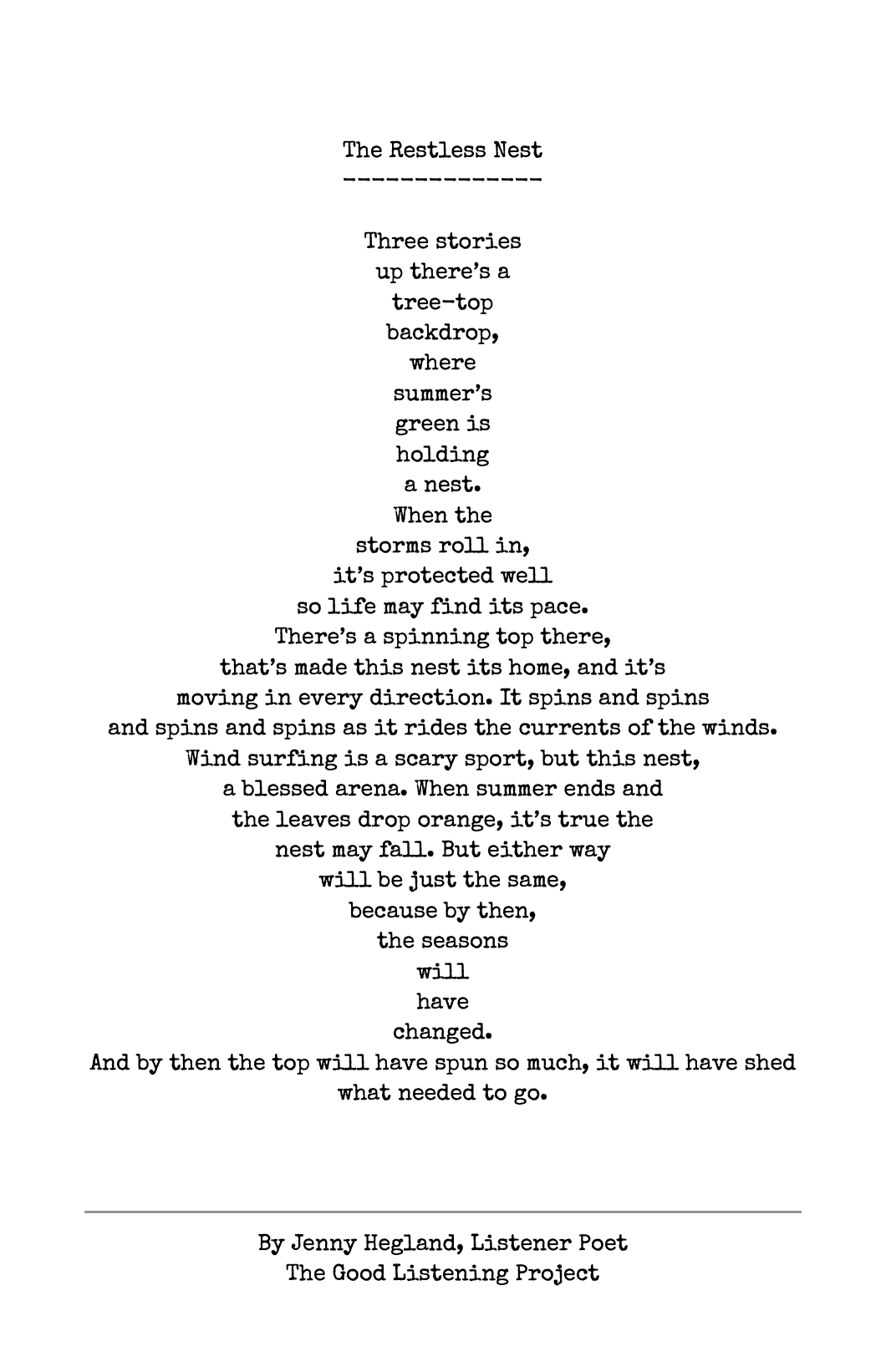
The Restless Nest
By Jenny Hegland, Listener Poet
Three stories
up there’s a
tree-top
backdrop,
where
summer’s
green is
holding
a nest.
When the
storms roll in,
it’s protected well
so life may find its pace.
There’s a spinning top there,
that’s made this nest its home, and it’s
moving in every direction. It spins and spins
and spins and spins as it rides the currents of the winds.
Wind surfing is a scary sport, but this nest,
a blessed arena. When summer ends and
the leaves drop orange, it’s true the
nest may fall. But either way
will be just the same,
because by then,
the seasons
will
have
changed.
And by then the top will have spun so much, it will have shed what needed to go.
"How can I be so still and so exhausted at the same time? I am taking in and processing so much more information now," she said. "I feel like a spinning top, moving in every direction at the same time."
“Everything that could have gone wrong went wrong,” she said. She held her baby in her arms as she shared their birth story. Her daughter spent three weeks in the NICU, and she was there every day.
“I was at a birth recently and thought: This is why they are so afraid of us. They can’t control this” She sat on her couch with a mug of coffee. She is a queer, femme, mother of two who has worked in reproductive health for over two decades.
Interspersed with the joys and worries of being a gramma, she recounted her own grandparents – challenges and opportunities of caring for them, grief of losing them, gratitude for being loved by them, and the everyday experiences of now living in their home.
What is pain without a diagnosis? This is what occupied this patient before she even received her breast cancer diagnosis about a year ago.
She told me that she picked her battles more and was trying to be less of a people pleaser.
He ended up talking about his son, who is now his daughter. Another part of his experience of continual growth and soul-opening.
Her values and perspective on life had changed as she considered ways to spend more time with her husband.
“When I see an old dude who’s optimistic, living his life, I always stop to talk to him to try to find out what he has done.”
This nurse was considering leaving a position where she spent many years due to issues she experienced and witnessed at her hospital.
Many of the people he worked with had to develop a new identity in the context of their caregiving responsibilities. “It’s as if they need to become a new variant of themselves.”
“We’re taught to enter a room with a specific goal... with assumptions... with a hypothesis about what may be going on with the patient.”
She believes that most of those who have connected with ACS began with a personal connection, but then, according to her, “you evolve, and you shift.”
With her background in counseling and psychology, she works to bring people together and support patients.
Although at times she becomes discouraged about the inequalities in the world, she is determined to do her part by making sure everyone has access to quality healthcare.
This person radiated gratitude and hope. She shared that she discovered she was expecting a son just before receiving a lung cancer diagnosis at the age of 31.
She had an epiphany as a child — that love could heal the world. Now, as a seasoned physician, there’s still a part of her that believes in the power of love, but not with the same idealism she once held.
He talked about recently speaking with a patient who experiences migraines: she is seeking the truth, he is seeking the truth to find a way to work with her, wanting to give more than a diagnosis and prognosis.
To her, the surgical world has felt like “a wheel that keeps spinning,” a seemingly endless pursuit towards an undefinable goal.
While she kept an open mind throughout medical school, the field of OB/GYN ticked off all the boxes for her.
“The historic traumas of African-American women — all African-Americans — lead us to not be the first people at the doctors, nor the first to get surgery.”
“Sometimes I feel so helpless,” said this resident, reflecting on all of the challenges faced by the young patients and their families whom she served. Over the last several days, she has become increasingly overwhelmed by events in the news and has questioned her ability to make a difference in the world.
“It’s hard to watch the decline and sometimes hard to visit but it weighs on me not to,” she said. Her father had always been an elaborate storyteller and an alive, vibrant man with a big voice.
The Good Listening Project was honored to once again take part in the annual KNN conference in Minneapolis this year. Jenny closed the session by writing this harvest poem that captured the voices and sentiments shared.
After a history of crippling endometriosis, this woman had an arduous, ongoing struggle with her healthcare community for the right to have a hysterectomy. She was finally granted approval at the age of 29. “It had been like pulling teeth, but finally I felt free,” she told me.
Her childhood was infused with Hawaiian-Polynesian music and dance, taught to her father by his mother. Today, her life’s work is to connect the unbelievable discoveries of molecularly focused pre-clinical research directly to the patient experience of treatment.
She is a single mother born to a single mother and had to grow up fast. She is juggling a sticky work situation, her own anxiety and depression, and being away from home and her kids.
I was invited to create a group poem for forty participants at the Arts in Healing luncheon, hosted by the Inova Health Foundation in partnership with the board.
What does it mean for people living with Sickle Cell Disease to be seen, heard, and understood? For this person, it meant finding – and using – her voice to advocate for herself and for others.