Health Equity Programs Lead,
Co-Founding Team
Yvette Perry, PhD is a lover of music and books, an amateur photographer, and a collector of antique typewriters. A graduate of Lesley College, Purdue University, and University of Minnesota, Yvette was a member of Haraka Writers at the Black Cultural Center during her time as a Boilermaker.
She has a background as an administrator in medical school student affairs and admissions and currently is a medical school admissions consultant working with the Association of American Medical Colleges. She lives in Toledo, Ohio with her husband and mother-in-law and is the mother of adult twin daughters.
"I already had a mistrust of the healthcare system," he said. At first, he wanted to attempt to treat himself using home remedies. But he was led to innovative medical treatments by a caring Black female physician. "I'm about 85% now. I'll take that. It will be another year before I'm considered cancer-free."
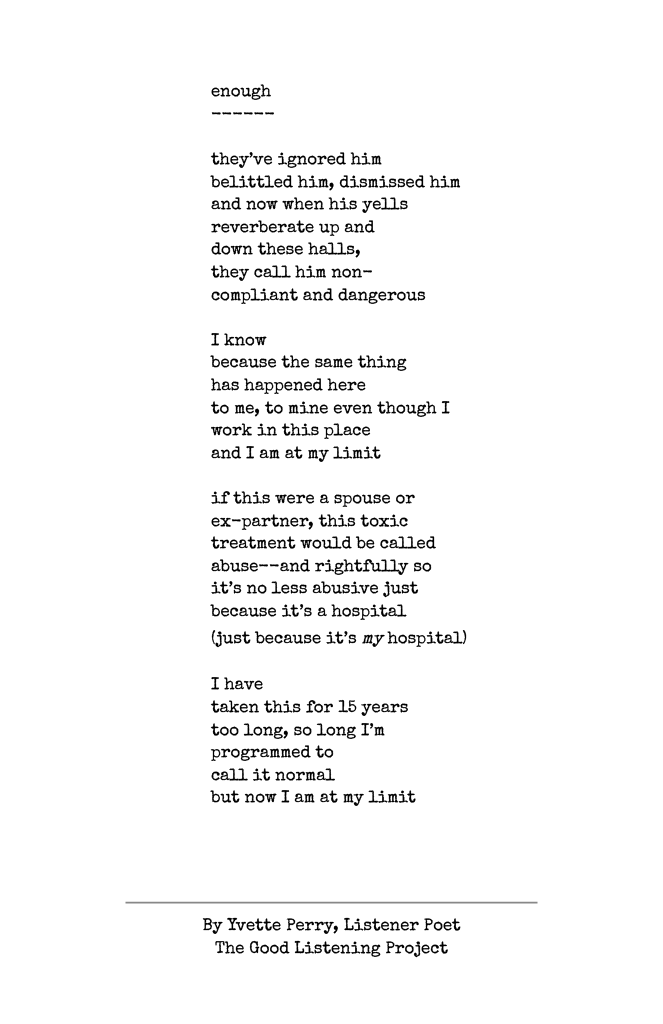
This nurse was considering leaving a position where she spent many years due to issues she experienced and witnessed at her hospital. Even though she worked there and was known to the healthcare providers, she experienced repeated incidents of disrespect and substandard care at the hands of her colleagues.
He noted that many of the people he worked with–mostly from communities underserved by the healthcare system–had to develop a new identity in the context of their caregiving responsibilities. "It's as if they need to become a new variant of themselves."
"What I've been thinking a lot about lately is hard to put into words," said this palliative care physician. At first she said this had to do with boundaries between herself as a physician and the patients and families she cared for–but she noted that this was perhaps not a precise enough word.
This new physician was looking forward to starting her OB/GYN residency. Her original goal in undergraduate school was physician assistant studies. But a series of experiences led her to consider a different path: medical school.
“Sometimes I feel so helpless,” said this resident, reflecting on all of the challenges faced by the young patients and their families whom she served. Over the last several days, she has become increasingly overwhelmed by events in the news and has questioned her ability to make a difference in the world.
What does it mean for people living with Sickle Cell Disease to be seen, heard, and understood? For this person, it meant finding – and using – her voice to advocate for herself and for others.
Professionally, for this person, Henrietta Lacks’ story represents the need to critically examine our research infrastructure. “Private companies benefit from publicly-funded research without a requirement to give back to ensure the viability of future research.”
"I'd tell her it's OK to be loud...it's OK to challenge and to bring all of you into these spaces where no one looks like you..."
"It changed me; It changed the way I look at life," said this woman about her profound experience during her pregnancy.
"I've been processing how to make the most of the small amount of life we have to live," said this physician.
This physician discussed being the only one in his practice network with expertise in patients with a specific type of chronic pain.
"I grew from the experience – though I think it aged me 10 years!" This is how a resident described a turning point with a specific patient when he recognized how burned out he was.
He had recently lost his father to COVID-19 and was reflecting on forgiveness. For the majority of his life with his father, they did not have a positive relationship. However, in the last three years of life, his father lost his memory and his personality changed into someone who was loving and kind.